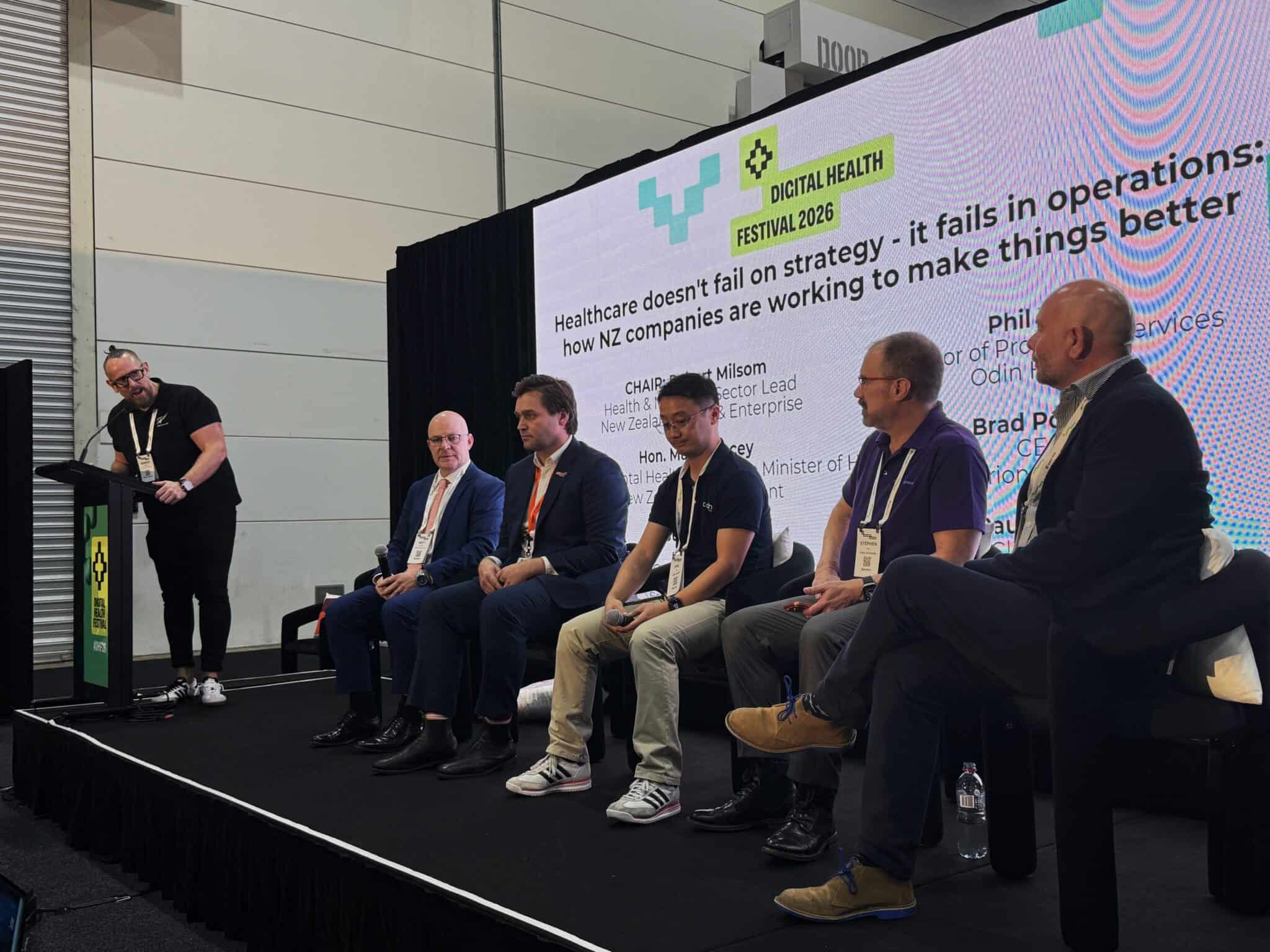
This year’s Digital Health Festival in Melbourne has seen twenty-six New Zealand health tech companies attend as part of an official delegation led by Government Minister Matt Doocey.
In his roles as Minister for Mental Health and Associate Minister of Health, Mr Doocey made a number of presentations at DHF 2026, including one titled “From innovation to global impact: how New Zealand is shaping the future of health tech.”
He noted health tech was one of New Zealand’s largest and fastest-growing technology subsectors, contributing $3.9 billion to the New Zealand economy in 2025.
Mr Doocey told the DHF 2026 audience that New Zealand’s health system was still being held back by “outdated, disconnected technology,” with many hospitals continuing to rely on paper-based notes and fragmented information flows between hospitals and general practice.
Positioning New Zealand’s recently announced 10-year Health Digital Investment Plan as a practical delivery roadmap rather than another high-level strategy, Mr Doocey said the programme would be used to “hold government to account” on timelines and implementation.
He said the phased approach – stabilise, modernise and transform – was intended to first address core infrastructure and interoperability gaps before enabling more advanced AI-supported and patient-centred models of care.
Mr Doocey also stressed the importance of national consistency for vendors and implementers, arguing the sector needed “one set of standards” to support scalable deployment across the country rather than fragmented district-by-district approaches.
HealthX
Touching on trans-Tasman collaboration, he pointed to New Zealand’s HealthX innovation programme, which has been testing AI medical scribes in emergency departments with Australian and New Zealand suppliers ahead of a national procurement process for approved providers.
He also linked digital health investment to wider mental health reform efforts, noting that recent survey work found many New Zealanders reporting unmet need not because services were unavailable, but because they “didn’t know where to go,” prompting the government to pilot AI-enabled navigation and triage tools.
Mr Doocey noted the 2026 delegation was the largest-ever New Zealand presence at the Digital Health Festival, “with participation having grown every year – a sign of the strong momentum across the industry.”
The Minister also appeared on a panel titled “Healthcare doesn’t fail on strategy – it fails in operations: how NZ companies are working to make things better,” hosted by New Zealand Trade and Enterprise Health & Medtech Sector Lead Robert Milsom and featuring Orion Health CEO Brad Porter, Odin Health Director of Product & Services Phil Xue, Core Schedule CEO Stephen Pool, and Cubro Client Partnerships Principal Paul Angus.
In a statement, NZTE said more than 80 per cent of New Zealand’s $3.9b health tech revenue was earned offshore – with Australia the largest tech export market.
New connections
NZTE said the delegation would allow “Kiwi digital health companies to build new connections,” noting “the festival brings together more than 8,000 health leaders, innovators and decision-makers – making it one of the largest digital health events in the Southern Hemisphere.”
NZTE hosted three sessions across the programme – including an opening acknowledgment of country and panels on strengthening healthcare operations and Indigenous data sovereignty.
The New Zealand Pavilion would “bring our digital health capability together in one place and make it easier for Australian health leaders to discover and connect with New Zealand solutions.”
While in Australia, Mr Doocey would also visit Mental Health Commissions in Queensland, Victoria, and Western Australia.
“The Mental Health and Wellbeing Commission has been an independent Crown entity in New Zealand for five years now. As a requirement, a review of the commission is to be undertaken.
“This is the first time there has been a review since establishment and it’s important that we get it right.
“This is an incredibly important role that holds any Government of the day to account. As we head into the review, I look forward to the opportunity to meet with commissions in Australia to hear directly from them about what’s working, what’s not and how they have best utilised the commission.”
Mr Doocey also led last year’s delegation to DHF, where 23 New Zealand companies took part.